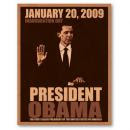
KM's comment on the last blog introduces the idea of what it means to be human. Obama's clarion call, "Yes we can" may more accurately be rendered, "Yes we can, because we can." It is axiomatic that humans cannot do what humans cannot do. When individuals suggest that war is normative they usually mean that peace keeping is not normative. It is this perspective that is false. Humans wage war because it is part of human nature to wage war against their enemies. Humans are also naturally prone to maintain peace with those they consider to be like them.
It is obvious that the problem is not that we wage war but who we consider to be our enemies. When humans first appeared on the planet they could not have viewed each other as enemies or the race would not thrive. At some point we became partisan in our thinking to the point that we magnified our differences and viewed other humans as being our enemies. If we can determine how we lapsed into this state it is possible that we could resolve all our violent conflicts. This is the Obama challenge in this non-partisan era.
Friday, January 30, 2009


Wednesday, January 28, 2009
Real Peace should last
I have come to realize that one of the most difficult concepts for humans to deal with is the idea expressed at the end of the last blog, that conflict is caused by humans who used to be peaceful. As a result we find ourselves attempting what Einstein said was impossible: trying to solve a problem with the same mind that cause the problem in the first place.
A similar situation exists in the field of education. Bill Gates has been infusing millions of dollars to deal with inequities within the education system. The problem is that the inequities within the education system were not introduced by uneducated people. Nor were they necessarily caused by graduates of the types of bad schools that are being upgraded with money from the Gates Foundation. We used to have a great education system and the products of that system caused parts of it to fall into ruin. Even if we were able to accomplish what the Gates Foundation wants to accomplish we would only return to the first page of the same book. It will not be long before the same process that brought parts of the education system to ruin begins again.
The same is true of the peace process. Former US Senator George Mitchell is correct: "There is no conflict that cannot be resolved. Violent conflict is created and sustained by human beings, and it can be ended by human beings." But it is not enough to end all conflicts. It is not enough to obtain a just peace or a long-lasting peace. Those are admirable goals but they only return us to the first page of the same book.
We need to create a set of circumstances that will ensure that humans will never again have the need to create violent conflict.
Here I recall Abraham Lincoln's call at his Second Inaugural:
With malice toward none; with charity for all; with firmness in the right, as God gives us to see the right, let us strive on to finish the work we are in; to bind up the nation's wounds; to care for him who shall have borne the battle, and for his widow, and his orphan--to do all which may achieve and cherish a just and lasting peace among ourselves, and with all nations.
A similar situation exists in the field of education. Bill Gates has been infusing millions of dollars to deal with inequities within the education system. The problem is that the inequities within the education system were not introduced by uneducated people. Nor were they necessarily caused by graduates of the types of bad schools that are being upgraded with money from the Gates Foundation. We used to have a great education system and the products of that system caused parts of it to fall into ruin. Even if we were able to accomplish what the Gates Foundation wants to accomplish we would only return to the first page of the same book. It will not be long before the same process that brought parts of the education system to ruin begins again.
The same is true of the peace process. Former US Senator George Mitchell is correct: "There is no conflict that cannot be resolved. Violent conflict is created and sustained by human beings, and it can be ended by human beings." But it is not enough to end all conflicts. It is not enough to obtain a just peace or a long-lasting peace. Those are admirable goals but they only return us to the first page of the same book.
We need to create a set of circumstances that will ensure that humans will never again have the need to create violent conflict.
Here I recall Abraham Lincoln's call at his Second Inaugural:
With malice toward none; with charity for all; with firmness in the right, as God gives us to see the right, let us strive on to finish the work we are in; to bind up the nation's wounds; to care for him who shall have borne the battle, and for his widow, and his orphan--to do all which may achieve and cherish a just and lasting peace among ourselves, and with all nations.
Tuesday, January 27, 2009
Peace at hand?
It is obvious that world peace is on Barack Obama's radar. He spoke of it often during his campaign and he has demonstrated his commitment by taking on the problems in the Middle East. But we must not be satisfied with seeking a just peace, as the language emanating from the President seems to indicate. We must look for a lasting peace.
All of this must be viewed in the context of his historic election. It is more important what Americans have become than the fact that the president is biracial or black.
By electing Barack Obama while whites are still a majority in the United States Americans have demonstrated that they have come to the point where they can recognize the humanity of each individual. If we desire a lasting peace we must nurture this awakening.
All wars stem from a refusal to recognize the humanity of others and peace depends on our ability to recognize the same.
We need a peace that cannot be broken. We must take note that our conflicts were caused by humans who were once peaceful.
All of this must be viewed in the context of his historic election. It is more important what Americans have become than the fact that the president is biracial or black.
By electing Barack Obama while whites are still a majority in the United States Americans have demonstrated that they have come to the point where they can recognize the humanity of each individual. If we desire a lasting peace we must nurture this awakening.
All wars stem from a refusal to recognize the humanity of others and peace depends on our ability to recognize the same.
We need a peace that cannot be broken. We must take note that our conflicts were caused by humans who were once peaceful.
Sunday, January 25, 2009
A changed America
One of the puzzling things about the media coverage of Barack Obama's rise to the presidency is the unwillingness to explore the link between the 44th first US presidency of Barack Obama and the 1st US presidency of George Washington. In part this is because we feel we must refer to Obama as the first black president because he is half black, even though being half white does not identify him as the first white president. But this focus on Obama's race or ethnicity ignores the pivotal role that the American people played in this election.
We the People of 2009 are not the same as We the People of 1789. In 1789 Americans had enforced a change in their identity by emphasizing that all men are created equal. But the man they chose as their President did not fully reflect We the People because some of the People were denied their full humanity and were excluded from the pool of presidential contenders. They were arbitrarily considered to be 3/5 ths of a person. But the actual fraction used was less important than the fact that they were not treated as any other human in the nation would be.
Referring to Obama as the first black president advances the false notion that it was necessary for America to have a black president or from any other ethnic minority. The Constitution does not advocate a revolving presidency among America's ethnic groups.
But the spectre of slavery made it necessary that a majority white should elect one who could not have been elected when the nation was formed. It would not have been the same if the election of the first non-white to the highest office in the land had only occurred when whites were a minority in America.
We the People of 2009 are not the same as We the People of 1789. In 1789 Americans had enforced a change in their identity by emphasizing that all men are created equal. But the man they chose as their President did not fully reflect We the People because some of the People were denied their full humanity and were excluded from the pool of presidential contenders. They were arbitrarily considered to be 3/5 ths of a person. But the actual fraction used was less important than the fact that they were not treated as any other human in the nation would be.
Referring to Obama as the first black president advances the false notion that it was necessary for America to have a black president or from any other ethnic minority. The Constitution does not advocate a revolving presidency among America's ethnic groups.
But the spectre of slavery made it necessary that a majority white should elect one who could not have been elected when the nation was formed. It would not have been the same if the election of the first non-white to the highest office in the land had only occurred when whites were a minority in America.
Friday, January 23, 2009
The Peace Enigma
Our search for peace is the best indicator that lasting peace is possible. Given the high cost of seeking peace humans would not seek peace if making war was our natural bent. On the other hand, given the high cost of war it is a wonder that humans continue to wage war.
Thursday, January 22, 2009
The pursuit of peace
With his appointments of Sen. Mitchell and Amb. Holbrook President Obama has demonstrated that he wishes to be active in the pursuit of peace.
In his Second Inaugural address Pres. Abraham Lincoln, Pres. Obama's model, called on a weary nation to “strive on . . . to do all which may achieve and cherish a just and lasting peace among ourselves and with all nations." During the National Prayer service prayer was made for just and lasting peace. There can be no doubt that Pres. Obama is interesting in a just peace and schieving such will be difficult. It will be even more difficult to achieve a lasting peace.
Peace that has to be maintained with the threat of violence is not a lasting peace. We seek peace because we are inherently a peace-loving species. Wars between humans are an anomaly. To expand on Sen. Mitchell's view that problems caused by humans can be solved by humans, we need to understand that we somehow slipped from a world at peace to a world at war by our own doing and it is up to us to find the way back. We need to demonstrate our commitment to achieving lasting peace by applying all we have learned about problem solving to this problem.
The first step is to attain a full understanding of the problem and how it began.
In his Second Inaugural address Pres. Abraham Lincoln, Pres. Obama's model, called on a weary nation to “strive on . . . to do all which may achieve and cherish a just and lasting peace among ourselves and with all nations." During the National Prayer service prayer was made for just and lasting peace. There can be no doubt that Pres. Obama is interesting in a just peace and schieving such will be difficult. It will be even more difficult to achieve a lasting peace.
Peace that has to be maintained with the threat of violence is not a lasting peace. We seek peace because we are inherently a peace-loving species. Wars between humans are an anomaly. To expand on Sen. Mitchell's view that problems caused by humans can be solved by humans, we need to understand that we somehow slipped from a world at peace to a world at war by our own doing and it is up to us to find the way back. We need to demonstrate our commitment to achieving lasting peace by applying all we have learned about problem solving to this problem.
The first step is to attain a full understanding of the problem and how it began.
Monday, January 19, 2009
Truthfully
The Presidency of Barack Obama reveals the beauty of the American political system. But even while we celebrate the nation's first dark-skinned president we need to remember that the same system that brought him to the White House will also usher him out. In four, hopefully eight, years Barack Obama will no longer be the President of the United States. What will America be like in the years following this unique Presidency?
To answer this question we need to recall a few realities. America was filled with hope when George Washington became the nation's first President. Against all odds they had overcome the might of Great Britain. They had drafted a masterful Constitution that continues to be a model for nations around the globe. But in a few decades the nation was torn apart by a devastating Civil War. The journey forward had been interrupted by giant steps backward because they had not come to terms with the conditions of the Revolution.
The Revolution that gave rise to the new nation was based on the idea that all men are created equal. But written into the Constitution was the admission that some people in this new nation were not equal, for they were not fully human. The Civil War reminds us that those who step forward can step backward if they do not speak power to the truth. The Civil War was inevitable as long as some of the nation's unrecognized citizens were deprived of their full humanity.
It is remarkable that Barack Obama was elected in an environment where we failed to speak power to truth. The economic meltdown was the result of the Wall Street lie of unfettered and unlimited wealth and prosperity. The Madoff led Ponzi scheme that cost fifty billion dollars was based on another lie. The failure to speak power to truth has its consequences.
If we want to ensure that we do not step backward after the next four or eight years we must not adopt another lie.
Barack Obama is the product of an Negro from Kenya and a Caucasian from Kansas. If being half-black makes him the first black American President, what would being half-white make him? If we go through the next four, or eight years seeing him as the first black President we may be preparing for major steps backward. We have entered the post-partisan era and must ensure that we do not lay the foundation for going backward.
If we keep looking for the change that he will bring then we have forgotten that just as it happened with George Washington, it was change that brought Barack Obama to Washington. Americans have changed. For the first time all Americans are equal. But we can go back if we are not careful.
As we go forward under the leadership of America's first dark-skinned President let us ensure that the change we have experienced is never reversed.
To answer this question we need to recall a few realities. America was filled with hope when George Washington became the nation's first President. Against all odds they had overcome the might of Great Britain. They had drafted a masterful Constitution that continues to be a model for nations around the globe. But in a few decades the nation was torn apart by a devastating Civil War. The journey forward had been interrupted by giant steps backward because they had not come to terms with the conditions of the Revolution.
The Revolution that gave rise to the new nation was based on the idea that all men are created equal. But written into the Constitution was the admission that some people in this new nation were not equal, for they were not fully human. The Civil War reminds us that those who step forward can step backward if they do not speak power to the truth. The Civil War was inevitable as long as some of the nation's unrecognized citizens were deprived of their full humanity.
It is remarkable that Barack Obama was elected in an environment where we failed to speak power to truth. The economic meltdown was the result of the Wall Street lie of unfettered and unlimited wealth and prosperity. The Madoff led Ponzi scheme that cost fifty billion dollars was based on another lie. The failure to speak power to truth has its consequences.
If we want to ensure that we do not step backward after the next four or eight years we must not adopt another lie.
Barack Obama is the product of an Negro from Kenya and a Caucasian from Kansas. If being half-black makes him the first black American President, what would being half-white make him? If we go through the next four, or eight years seeing him as the first black President we may be preparing for major steps backward. We have entered the post-partisan era and must ensure that we do not lay the foundation for going backward.
If we keep looking for the change that he will bring then we have forgotten that just as it happened with George Washington, it was change that brought Barack Obama to Washington. Americans have changed. For the first time all Americans are equal. But we can go back if we are not careful.
As we go forward under the leadership of America's first dark-skinned President let us ensure that the change we have experienced is never reversed.
Subscribe to:
Posts (Atom)